Block puzzle tips: 12 ways to beat your high score
Most 8x8 block puzzle games end the same way: the board fills up, a big piece arrives, and nothing fits. The good news is that almost every lost game comes from a few habits you can fix. These tips work in any block puzzle, including Gridwit.
Keep the board open
1. Play the edges and corners first. The middle of the board is the most valuable space you have, because every big piece needs it. Park awkward pieces along the walls and in the corners, and keep the centre as empty as you can.
2. Always leave room for a 3x3 square. The 3x3 block is the piece that ends most games. Before every move, ask yourself: "If a 3x3 came next, where would it go?" If the answer is nowhere, change your move.
3. Leave room for the long line too. The 1x5 and 5x1 bars are the second most common game-enders. Keep at least one full open row or column, or a clean five-cell gap, available at all times.
4. Avoid single empty holes. A lonely empty cell surrounded by blocks can only be filled by a 1x1 piece. One hole is annoying, three holes and the row will never clear. If a move creates a hole, look for another spot.
Think about all three pieces
5. Look at the whole hand before you place anything. You get three pieces per round and you can place them in any order. Place the biggest or most awkward piece first, while you still have the most space.
6. Plan the order so one piece makes room for the next. Often the first piece completes a line, the line clears, and suddenly the second piece fits. Try the order in your head before you drag.
7. Do not panic-place. In untimed modes there is no clock. Take a second on every hard hand. Most game-ending mistakes are fast moves, not bad luck.
Score more with combos
8. Clear lines on back-to-back moves. In most block puzzles, and in Gridwit, clearing on consecutive moves builds a combo, and a combo multiplies your score. Setting up two or three clears in a row is worth far more than one big clear followed by nothing.
9. Build "almost full" lines on purpose. Keep two or three rows or columns one piece away from clearing. Then any small piece that arrives can trigger a clear and keep the combo alive.
10. Clear rows and columns at the same time. A piece that completes both a row and a column at once clears more cells and scores more. Look for the cross where an almost-full row meets an almost-full column.
11. Go for PERFECT clears when they are close. Emptying the whole board gives a big bonus in Gridwit. When only a few blocks are left on the board, it is often worth one extra move to wipe it completely.
Play smarter over time
12. Learn from the game that ended. When you lose, look at the board for a second before you tap "play again". Was the centre full? Were there holes? Was there no space for the 3x3? You will usually spot the same mistake, and fixing it is the fastest way to a new high score.
Want to practise a specific skill? Time Rush trains fast decisions, Starlight rewards planning where you place your pieces, Adventure gives you goals with limited moves, and the Daily Puzzle is a fresh, always-solvable challenge every day.
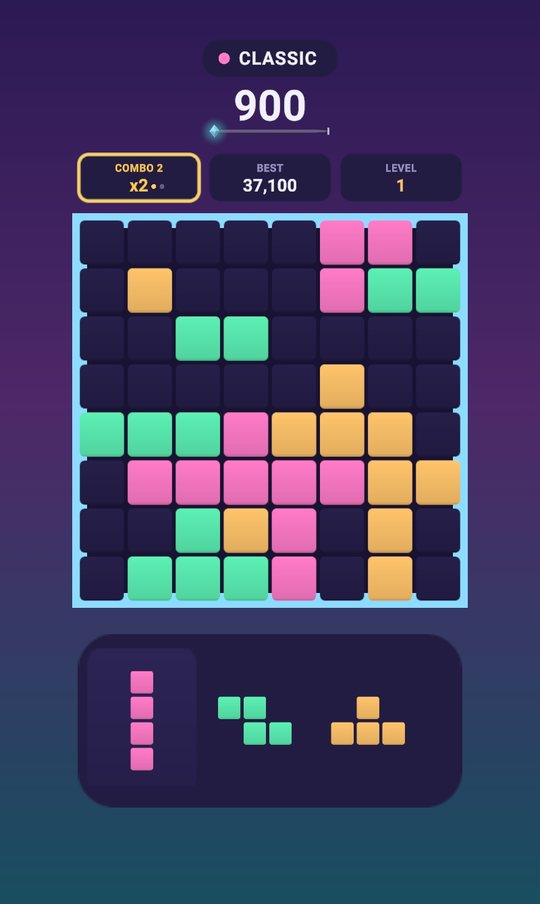
Try it on Gridwit
Gridwit is a free 8x8 block puzzle for Android with six modes: Classic, Time Rush, Starlight, Adventure (54 levels), Daily Puzzle and Zen. Fair pieces, big combos, a ranking and far fewer ads than most block puzzles.
Questions
What is the best strategy for block puzzle games?
Keep the middle of the board open, always leave space for a 3x3 square and a 5-cell line, avoid single empty holes, and place the most awkward piece of your hand first.
How do combos work in block puzzle games?
In most block puzzles, including Gridwit, clearing lines on back-to-back moves builds a combo that multiplies your score. Keeping a few lines almost full makes it easier to keep the combo going.
Why do I always lose to big pieces?
Usually because the centre of the board filled up. Play awkward pieces along the edges and check before every move that a 3x3 square would still fit.